

Pro-abortion activists are lying to you. And Boise State University is stonewalling our efforts to discover the truth.
Now we’re suing Boise State University—and you won’t believe the backstory.
You might remember the media coverage on a study published by JAMA Network Open last summer, claiming that physicians were leaving Idaho because of our pro-life laws. The study was conducted under institutional review board approval from Boise State University—and one of the authors is a BSU professor.
We weren’t buying their claim that Idaho experienced a 35% net decrease in physicians practicing obstetrics since the Heartbeat law and Defense of Life Act took effect in August 2022.
So we had Grace Howat – one of our policy analysts – file two public records requests. The first was with the Idaho Board of Medicine, requesting the number of OB/GYNs holding an active license in the state. The second was with Boise State University, requesting the data set and documents related to the JAMA study.
The Idaho Board of Medicine fulfilled our request immediately. Interestingly, the number of actively licensed OB/GYNs actually increased over the last few years, according to their data:
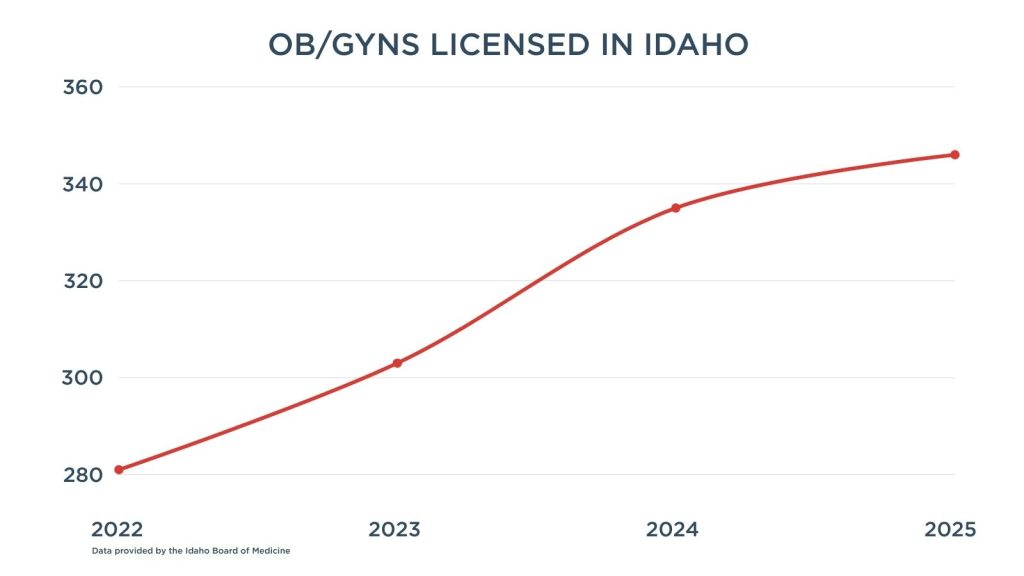
In fact, the number of actively licensed physicians declaring OB/GYN as their specialty increased by nearly 20% between 2022 and 2024, a similar time frame to that considered by the JAMA study. And that number is still growing—with the most recent data available from 2025 showing an additional 3.3% year-over-year increase in the number of Idaho licensed OB/GYNs.
This data is admittedly imperfect. Not all physicians actively practice in the state where they’re licensed. Furthermore, the Idaho Board of Medicine allows physicians to self-report their specialty—and they’re not even required to declare any specialty at all.
Even still, it’s the best data available. And it clearly shows that the number of Idaho OB/GYNs hasn’t been decreasing at the rate that JAMA article researchers – and their boosters in the media – have been telling you.
All this raises the question: What data did the Boise State University professor and other authors use when performing their research for the JAMA article?
We don’t know—because Boise State University refused to provide it.
Unlike the state medical board – which provided their data within the 10-day limit allowed by Idaho law governing public records requests – BSU refused to fully comply with the public records request filed by IFPC.
Here’s the timeline of what took place—which clearly illustrates BSU’s obstruction:
DAY 1: IFPC Policy Analyst Grace Howat files a public records request with Boise State University asking for all documents related to the JAMA study. BSU immediately responds that it will take 3-10 working days to fill the request.
DAY 13: BSU responds to Grace—requiring “advance payment” before completing the request, despite already missing the statutory ten-day deadline for providing the information. IFPC provides advance payment.
DAY 36: Grace – having not received any correspondence from BSU – sends a follow-up email asking about the status of her public records request. She receives no response.
Day 47: Grace sends another follow-up email—but this time, she copies in Caleb Pirc, who serves as general counsel for IFPC. At this point, BSU has already violated the deadline set by the public records law by more than one month.
DAY 48: BSU finally responds—one day after IFPC’s general counsel gets involved. BSU claims that the only relevant document they have is a two-page file with some abstract data.
But the two-page document that they sent didn’t include any useful information—and Grace knew that Boise State University was withholding data and documents. After all:
BSU instructor T. Allen Traylor was one of the authors of the JAMA article—but none of his email correspondence was provided.
The article thanked BSU Associate Professor Mac McCullough “for his analysis and editorial support,” but none of his email correspondence with the authors was provided.
All research for the article was performed under the authority of the BSU institutional review board, which requires researchers to submit a number of documents for review. But none of those documents were provided.
BSU also failed to provide any other underlying data, compliance documentation, funding documentation, peer review documentation, internal emails between BSU faculty working on the project, or external emails between BSU faculty and other researchers working on the project.
So Grace sent another follow up email to BSU, asking about these other documents. Her email was ignored.
Here’s the thing: Idahoans deserve to know the truth. BSU has played fast and loose with the requirements of Idaho’s public records law for a long time now. A senior leader at BSU admitted under oath that the university had changed file names to avoid providing documents in response to public records requests in a different case, as reported by Don Day for BoiseDev.
And that’s just the tip of the iceberg. Idaho EdNews has also exposed repeated instances of BSU dodging the Idaho public records law. As EdNews journalist Ryan Suppe explains:
Custodians of public records at state and local agencies are giving themselves extra time to respond to records requests—and undermining the intent of a law that requires a prompt reply when citizens ask to see government documents.
One of the best things about the law – and what makes it better than many similar laws in other states – is that it requires a “prompt response,” said Betsy Russel, a retired Idaho journalist and president of Idahoans for Openness in Government. Records custodians must grant or deny requests from Idaho residents within three working days, excluding weekends and holidays.
Timely responses help citizens find out what their government is doing in real time — not weeks, months or years later — and contribute to public policy decisions that affect their schools, communities and state.
Timeliness is certainly an issue here. We’ve been trying to get the BSU data for almost a year now. During that time, news journalists have peddled the study to drive the narrative that Idaho doctors are leaving the state.
But it’s not just timeliness. BSU isn’t even complying with the law. They’re refusing to make the information available to the public. And that’s a big issue, especially because the data seems to be contradicted by other sources, including the aforementioned report from the Idaho Board of Medicine.
There are questions here that demand answers: What does BSU have to hide? Why did they drag their feet for months—and only respond once our lawyers got involved?
And perhaps the biggest question: Are OB/GYNs actually leaving the state, as the JAMA study claims? Or is the number of OB/GYNs practicing in Idaho actually increasing, as the data from the Idaho Board of Medicine seems to indicate?
This lawsuit means that we’ll finally get the answers. And with the upcoming abortion ballot initiative, the need for accurate information has never been more crucial.
We’ll keep you updated.

One Response
I love that action is finally happening!
BSU is hiding what needs to be shared. They need to be held accountable.
The lies being told are hurting young women from the truth!